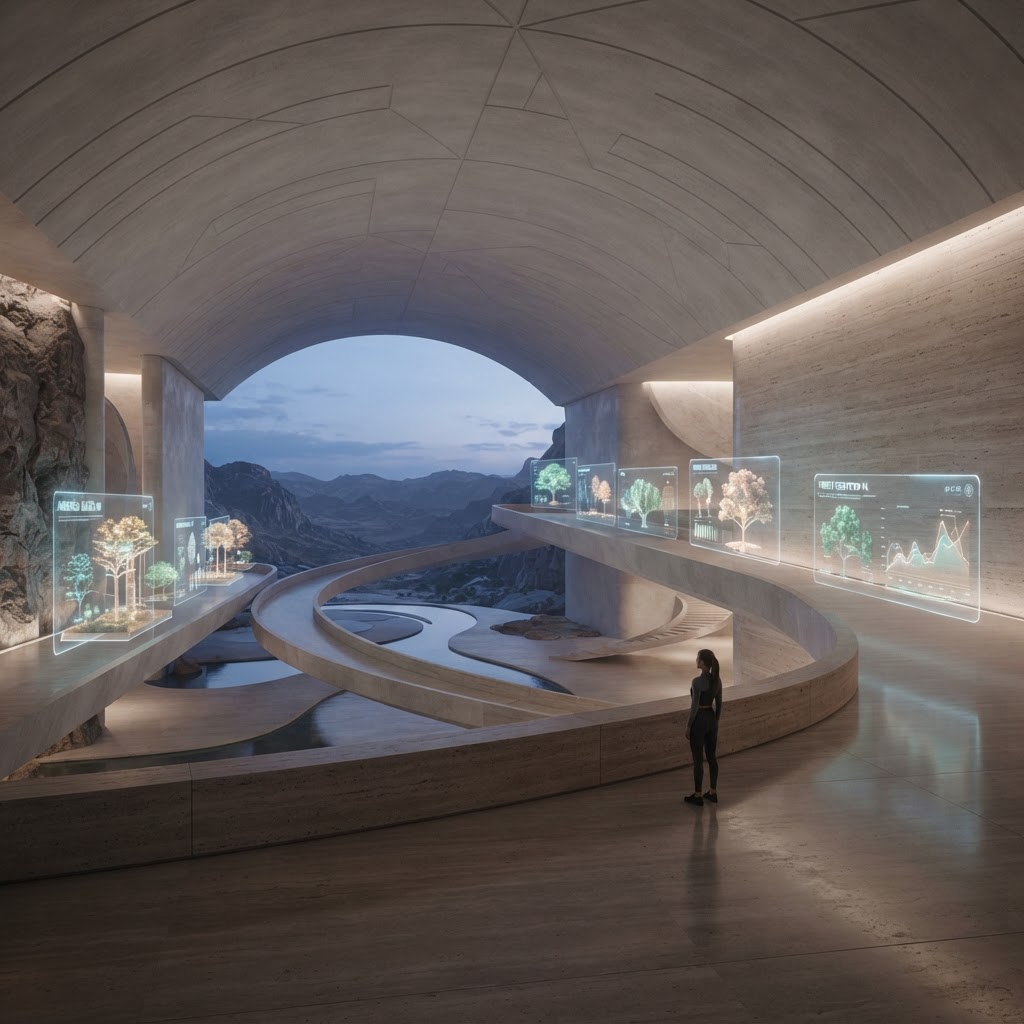
The Architecture of Presence: Engineering Three-Dimensional Brand Ecosystems for the Spatial Web Era
For decades, the digital experience has been confined to a rectangle. We have been observers on the outside looking in, scrolling through flat surfaces, clicking on digital billboards, and consuming content that—while often beautiful—remains fundamentally detached from our physical reality. But the era of the flat web is coming to an end. At 1976 Studios, we believe that the next frontier of storytelling isn’t found on a screen; it is found in a space. We are moving from the era of information to the era of Presence.
As we look toward 2026, the distinction between 'content' and 'environment' is dissolving. Founders, musicians, and purpose-driven brands no longer need mere websites; they need spatial brand ecosystems. They need three-dimensional worlds that their audience can inhabit, explore, and feel. This is the architecture of presence—a cinematic approach to digital life that prioritizes deep emotional resonance over transactional friction.
From Digital Billboards to Inhabited Ecosystems
The traditional approach to web design has been focused on optimization: how quickly can we get a user to click a button? How can we maximize 'time on page'? This is the language of the agency, not the studio. At 1976 Studios, we are not interested in optimizing campaigns; we are interested in creating culture. The spatial web allows us to treat a digital brand not as a series of pages, but as a physical place.
Imagine a conservation organization that doesn't just show you a video of a protected forest but allows you to stand within it. Imagine a musician whose new album isn't just a playlist, but a curated, atmospheric cathedral of sound and light that users can walk through. This shift from 'viewing' to 'inhabiting' transforms the user from a passive consumer into an active participant. This is the core of our philosophy: We Build Media. That Moves People.
Engineering the Spatial Web: The Power of the HTML <model> Element
The transition to 3D environments is no longer a futuristic dream or a resource-heavy gimmick requiring external plugins. With the emergence of visionOS 26 and the standardization of the HTML <model> element, high-fidelity 3D assets are now a native part of the browser's DNA. This is a revolutionary shift for immersive experience design.
By integrating complex, photorealistic 3D models directly into the web fabric, we break the 'uncanny valley' of digital interaction. At 1976 Studios, we leverage these tools to ensure that your brand world is seamless, lightweight, and accessible. Whether through a desktop browser or a spatial headset, the experience remains consistent. We aren't just adding 3D assets for the sake of novelty; we are using them to ground the user in a tangible reality. When a founder presents their vision through a spatial ecosystem, the audience doesn't just understand the data—they feel the scale of the ambition.
Hyper-Personalization through Spatial AI
Presence is not static; it is reactive. In the 2026 landscape, the most potent brand worlds will be those that breathe and change alongside the user. Through the integration of Spatial AI, 1976 Studios engineers ecosystems that adapt in real-time. This isn't the creepy, data-mining personalization of the past. It is an empathetic adjustment of the environment.
If a visitor returns to a nonprofit’s digital sanctuary, the space might reflect the growth of the projects they’ve supported. The lighting might shift to match their local time, or the architectural layout might expand to highlight areas of their specific interest. By using AI to modulate the 3D environment, we create a 'brand world' that feels uniquely theirs. This level of interactive media ensures that no two visits are the same, fostering a sense of long-term belonging rather than short-term engagement.
Digital Sobriety: Immersion Without Intrusion
As we build more immersive worlds, we must also address the growing demand for Digital Sobriety. The modern user is exhausted by the 'attention economy'—the constant pings, the high-friction pop-ups, and the addictive loops of traditional social platforms. A 1976 Studios production stands in stark contrast to this noise.
We believe that true immersion is not about stealing attention; it is about providing a meaningful, grounded space where attention can rest. Our spatial ecosystems are designed with ethical presence in mind. This means prioritizing user mental well-being by reducing clutter and focusing on 'flow.' We create digital sanctuaries where the UX design is intuitive and invisible. In these spaces, users aren't being sold to; they are being invited to reflect. It is a cinematic approach to the web—using silence, space, and focus to tell a story that lingers long after the headset is removed or the tab is closed.
Atmospheric Perception and the Mineral Palette
The psychology of space is driven by atmosphere. To ground a user in a three-dimensional digital ecosystem, we utilize layered, mineral-toned color systems. Moving away from the neon, 'high-tech' aesthetic of early VR, we embrace earthy, textured, and atmospheric perceptions. We use deep ochres, slate greys, and oxidized coppers to create a sense of permanence and digital 'weight.'
These palettes aren't just aesthetic choices; they are tools for emotional regulation. By shaping the mood through color and lighting, we can guide the user’s emotional journey. This is where web design meets scenography. Every shadow cast in a 1976 Studios ecosystem is intentional. Every texture is designed to be felt. This focus on sensory architecture ensures that the digital space feels as real as the physical one, bridging the gap between the visionary’s mind and the audience’s heart.
The Visionary’s New Frontier
For the founders, creators, and visionaries of tomorrow, the question is no longer 'How do I build a website?' but 'What kind of world do I want my audience to live in?' The architecture of presence is about more than just technology; it is about the human need for connection, meaning, and awe.
At 1976 Studios, we provide the technical mastery and the cinematic vision to turn your brand into a living, breathing ecosystem. We move past the limitations of the flat screen to build the three-dimensional legacies of the future. The spatial web is here, and it is waiting for those bold enough to inhabit it.
Are you ready to build a world?
Don't just create content. Build a legacy. Connect with 1976 Studios today and let’s engineer a digital presence that truly moves people.