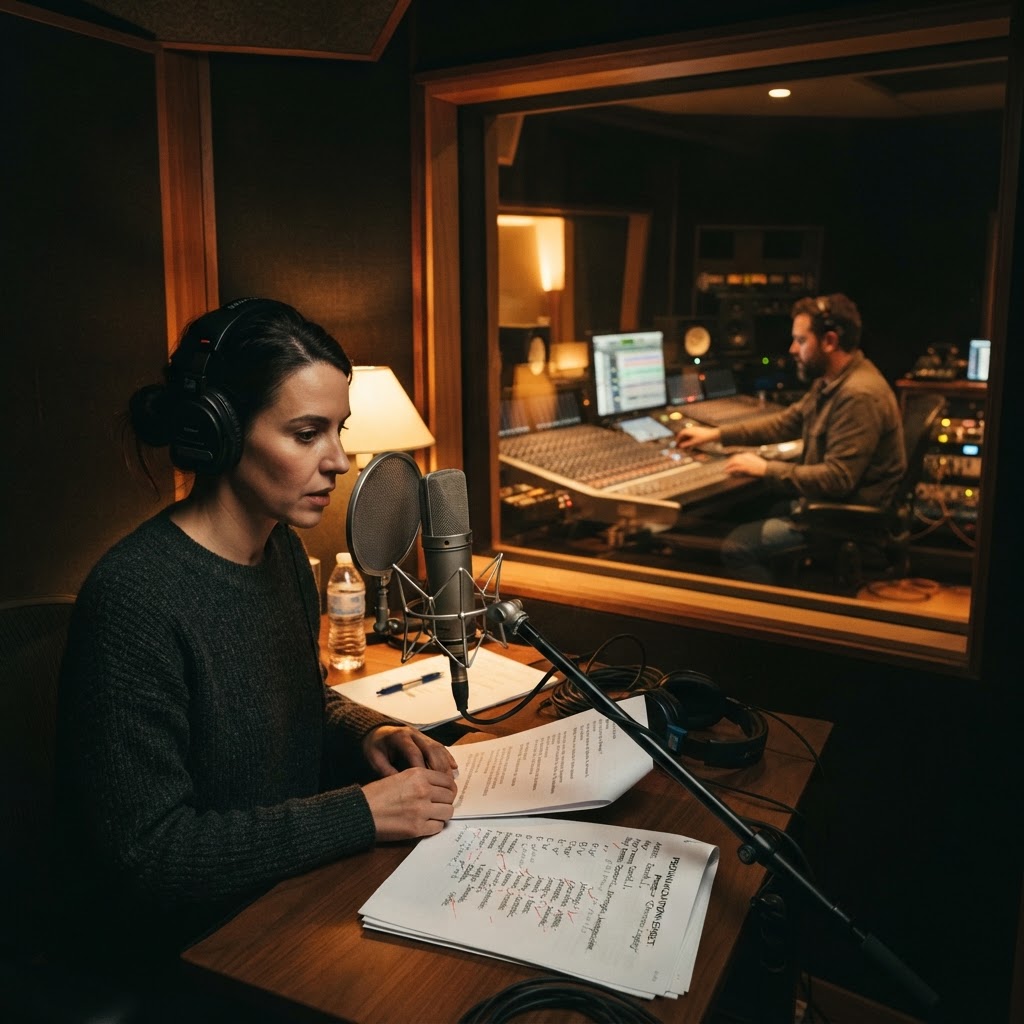
AI-generated concept illustration of a creative workspace and abstract visual forms. It does not depict a 1976 Studios session, employee, software interface or measured audio data.
A voiceover can sound confident and still get the most important name wrong. Before a narrator records your script, collect the words that need a deliberate decision: a founder's surname, a place name, a technical term or an acronym that your team says differently from the way it looks.
A short pronunciation sheet gives the session a useful reference. The exercise below is a suggested preparation method for a commissioned recording, not a description of a proprietary studio process.
Mark the words that deserve a check
Read the script aloud and highlight anything you hesitate over. Ask a person outside the project to do the same. Familiarity can hide ambiguities that a first-time reader will notice immediately.
Include names, initials, abbreviations, uncommon product terms and numbers whose spoken form matters. For each entry, keep the exact spelling used in the approved script and the sentence in which it appears. Context helps the narrator understand what the word is doing rather than rehearsing it in isolation.
Find someone who can confirm the intended reading
For a person's name, ask that person how they would like it spoken when practical. For an organization or project term, identify the representative responsible for confirming it. A colleague's confident guess should remain a guess until it is checked.
Where more than one pronunciation is acceptable, record which one this production will use and who made that choice. If confirmation is still outstanding, mark it as unresolved. Do not let an empty cell look like approval.
Give the narrator a usable reference
A brief voice recording can be helpful when written pronunciation notes are ambiguous. Ask the speaker to say the word by itself and then in the relevant sentence. Share only material you are permitted to provide to the production team.
Label the reference clearly and keep it beside the current script. Written syllable cues can supplement the recording, but agree on what the notation means. An improvised spelling that makes sense to one person may suggest a different sound to another.
Resolve abbreviations and numbers before the session
Decide whether an abbreviation should be read as letters, as a word or in its expanded form. Put the intended spoken wording in the script notes so the narrator does not have to infer the choice from surrounding copy.
For an imaginary software introduction, the team might prefer “version two point one” where the on-screen title reads “v2.1.” That is an editorial choice for the example, not a universal rule. Review dates, model numbers and measurements with the same attention to what the audience should hear.
Keep late changes visible
Give the pronunciation sheet the same version label as the script it supports. If a term changes, update the reference and point out the affected line. A replacement name buried in a new document is easy to miss during a busy session.
When reviewing the recording, check the flagged terms against the agreed references. Note the file version and timestamp for any correction. A pronunciation check answers a specific question; it does not replace reviewing factual accuracy, performance or the rest of the finished audio.
Bring a clear script to the project discussion
1976 Studios lists voiceover production alongside composition, mixing, mastering and cinematic scoring. Bring the current script, intended audience, pronunciation references and unresolved questions when discussing a recording.
Start Your Project with the words your audience needs to hear clearly and the context that gives them meaning.