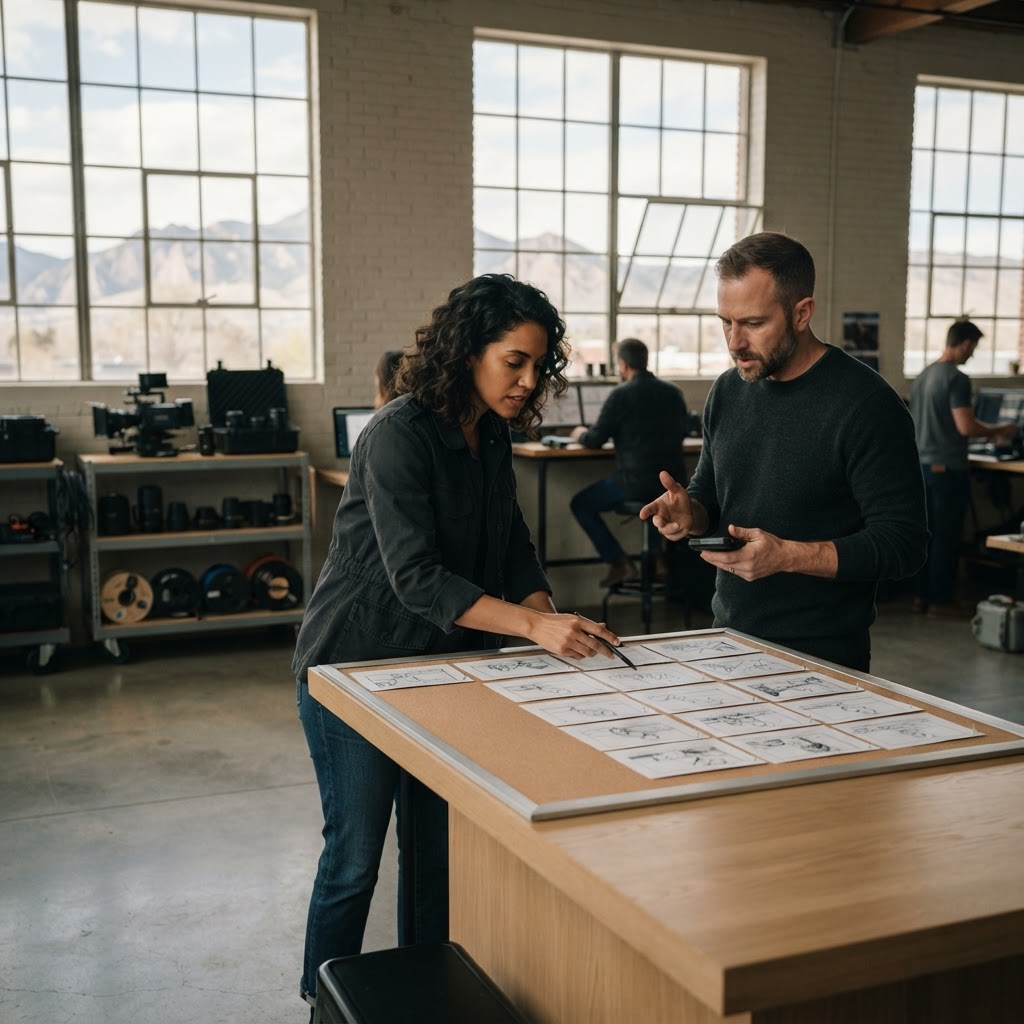
A beautiful close-up can become difficult to use when the editor has no clear view of what happened before or after it. Before filming an action, sketch how that action might become a short sequence.
This is a creative planning exercise, not a rule that every scene needs the same coverage.
Choose one action with a beginning and an end
Imagine a maker opening a workshop, selecting a tool and beginning a task. Write the action plainly before choosing camera movement. What must the audience understand? What detail makes the moment specific?
A wide view might establish the person and workspace. A detail could show the selected tool. A reaction or pause could tell us what the task means to the person. Each shot has a job beyond looking impressive.
Draw the likely cut
Use rough boxes or a few written lines. Place the shots in order and identify the moment where you expect to move from one to another. If the sequence requires an action to continue across the cut, note what needs to remain consistent between takes.
You do not have to lock the final edit in advance. The sketch reveals missing information while you still have time to capture it.
Ask for useful variations
Instead of filming every possible angle, identify the alternatives that would change the story. Does staying wide preserve the person's isolation? Does a close detail reveal something the audience would otherwise miss?
Keep the person's comfort, the location's constraints and safe production practice ahead of the shot list. Do not ask someone to repeat hazardous work for coverage.
Review a rough sequence early
When practical, assemble a simple version before leaving the location. Check whether the action is understandable, whether a transition feels abrupt and whether a missing view is actually necessary. A rough cut can expose a storytelling gap that reviewing individual clips does not.
1976 Studios works in cinematic production and editing. Bring the action you want the audience to understand, then plan the images that make that action readable and expressive.
Featured image: AI-generated editorial illustration.