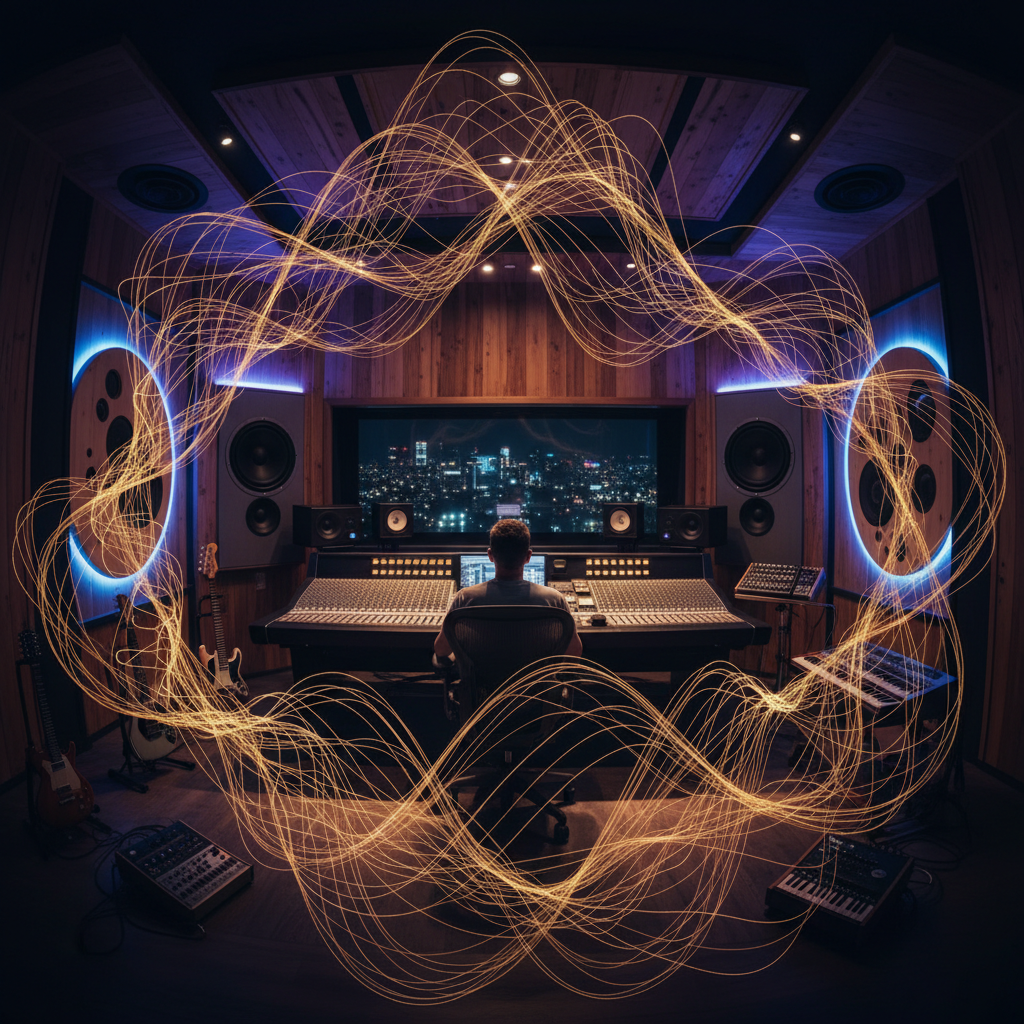
The Architecture of Presence: Breaking the Stereo Wall
For decades, we have been content to sit on one side of a glass window, watching stories unfold. In the world of sound, this window is the 'stereo wall.' It is a flat, two-dimensional representation of reality where sound moves left and right, but ultimately remains trapped within the confines of a rectangular frame. At 1976 Studios, we believe that for a message to truly move a person, it must do more than just reach their ears; it must inhabit their space. We are moving beyond observation and into the era of presence.
Beyond the Stereo Wall: From Observation to Participation
Traditional audio engineering has long focused on the balance of the mix—ensuring the vocals are clear and the instruments are panned correctly. But stereo is essentially a 'front-facing' experience. It keeps the listener at a distance. When a visionary founder or a nonprofit leader shares their 'why,' that distance is a barrier. It is the difference between looking at a photograph of a forest and standing in the middle of one, hearing the rustle of leaves behind you and the call of a bird high above.
By utilizing spatial audio, we are dismantling that wall. We are no longer just delivering content; we are constructing environments. This shift from 'stereo' to 'immersive' allows us to place the listener inside the heart of the narrative. When the soundscape wraps around the audience, the brain stops processing the information as a 'media file' and starts experiencing it as a 'memory.' This is the architecture of presence.
The Technical Bridge: Object-Based Audio and Emotional Resonance
The leap from traditional music production to immersive storytelling is powered by object-based audio. Unlike channel-based audio (where sound is sent to specific speakers), object-based audio treats every sound as an individual entity in a 3D space. Through advanced sound design, we can move a whisper, a swelling cello, or the crackle of a campfire anywhere in the room with pinpoint accuracy.
For the creator, this means that the scoring of a film or a brand anthem is no longer limited to volume and frequency. We now have a third dimension: depth. We can pull the audience closer to a speaker’s voice to create intimacy, or push a cinematic swell far into the distance to evoke a sense of awe. This technical precision serves a singular purpose: to remove the friction between the visionary’s intent and the audience’s emotional response.
The Organic Anchor: Field Recordings in a Digital World
In our pursuit of the future, we do not abandon the earth. To make immersive audio feel real, it must be grounded in the textures of the physical world. At 1976 Studios, we frequently integrate high-fidelity field recordings from rural environments and wild landscapes into our digital workflows. We believe that a studio recording should breathe.
Imagine a conservation organization seeking to protect an endangered ecosystem. We don’t just provide a voiceover; we transport the donor to the actual location. We use the organic soundscapes of the wind through the tall grass, the rhythmic pulse of a distant storm, and the nuanced 'air' of the wild to anchor the spatial experience. These textures provide the subconscious cues that tell the brain, 'This is real. This matters.' By blending these raw, natural elements with sophisticated audio engineering, we create living media that commands undivided attention.
The AI Paradox: Technology as a Vessel for the Human Soul
The rise of Artificial Intelligence in the creative arts has sparked a debate about the loss of the human touch. At 1976 Studios, we view AI not as a replacement for the creator, but as a tool for spatial positioning and complex calculation. AI allows us to render these intricate 3D environments with more efficiency, handling the heavy lifting of sonic geometry so that the human artist can focus on the soul of the story.
Technology should never be the headline; it should be the invisible hand that makes the experience possible. Our approach to music production and scoring remains fundamentally human-centric. We use AI to enhance the clarity of the vision, ensuring that the technology serves the message, rather than the message serving the tech. We are using the most advanced tools available to return to the oldest form of human connection: the shared story told around the fire.
The Visionary’s Edge: Why Immersion Inspires Action
Why does this matter for the founders, the dreamers, and the impact-makers? Because the world is louder than ever. In an age of infinite scrolling and transactional marketing, the greatest luxury is the listener’s presence. When you give your audience an immersive experience, you are giving them something they cannot find in a 15-second social media ad: you are giving them a feeling of belonging.
Whether it is a startup launching a disruptive technology or a musician releasing a career-defining album, the goal is the same—to move people. Spatial sound design and immersive scoring create a visceral connection that bypasses the logical brain and speaks directly to the heart. It is the difference between a campaign that is seen and a movement that is felt.
Building the Future of Sound
1976 Studios isn’t here to optimize your campaign; we are here to build your culture. We are a studio dedicated to those who understand that media is not a commodity—it is a conduit for change. Through the marriage of high-level audio engineering, cinematic sound design, and a deep respect for the power of human narrative, we are redefining what it means to listen.
The era of the stereo wall is over. It’s time to step inside the story.
Start Your Project
Ready to move beyond content and start creating culture? Let's build something that resonates.